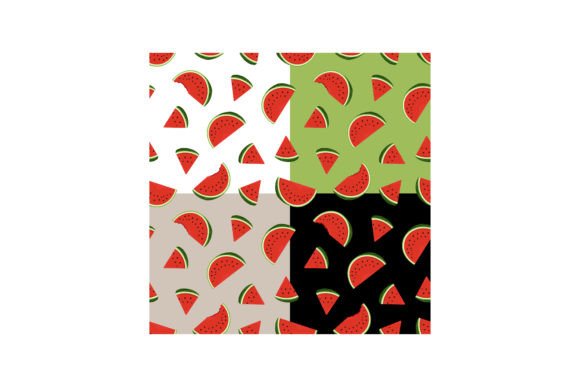
Watermelon Seamless Patterns Set
Imagine a crisp autumn afternoon—sunlight slanting through golden leaves, the scent of ripe fruit in the air, and a harvest basket brimming with watermelons: deep green rinds, vibrant pink flesh, and glossy black seeds catching the light. Now imagine translating that joyful, seasonal energy into design—not as isolated illustrations, but as repeatable, edge-to-edge patterns that flow endlessly across fabric, paper, or screen. That’s what a Set of Seamless Patterns with Watermelon delivers: thoughtfully crafted vector-based repeats featuring whole watermelons, sliced wedges, and stylized botanical accents—all designed to tile perfectly without visible seams.
More Than Just Fruit: Why This Pattern Set Fits Real Projects
Seamless patterns aren’t decorative afterthoughts—they’re functional design infrastructure. A Set of seamless patterns with watermelon slice doesn’t just look summery; it supports intentionality. The slices add rhythm and visual interest, while whole melons ground the composition. Together, they reflect the autumn harvest of watermelons—a less expected but increasingly popular theme in contemporary surface design, where freshness meets seasonal warmth.
Because these are vector files (typically .AI, .EPS, or SVG), they scale infinitely without pixelation. That means one pattern can wrap a child’s tote bag, line a greeting card, become the background of an Instagram story, or print across yards of organic cotton for a boutique clothing line—all from the same source file.
For Beginners Learning Design
If you’re just getting comfortable with tools like Adobe Illustrator or Affinity Designer, a Set of Seamless Patterns with Watermelon offers low-risk creative entry points. You don’t need to build a repeat from scratch—you can open a pattern, recolor it using global swatches, or drop it into a mockup template to see how it behaves on real products. No coding, no math, no trial-and-error tiling. It’s learning by doing—with immediate, satisfying results.
For Educators and Students
Design teachers use these patterns to demonstrate core concepts: repetition, rhythm, negative space, and color theory in context. A student might compare how changing the background hue shifts the perceived “seasonality” of the same watermelon slice motif—or explore how cropping alters emphasis. Because the set includes both whole and sliced variations, it becomes a built-in case study in motif hierarchy and visual storytelling.
For Small Business Owners & Makers
A ceramicist printing watermelon-patterned gift wrap? A candle maker labeling soy wax containers with harvest-themed labels? A quilter sourcing digital prints for limited-run fabric panels? Each needs reliability, commercial clarity, and ease of integration. A well-structured Set of seamless patterns with watermelon slice includes clean layers, documented licensing (often with extended commercial rights), and formats compatible with common print-on-demand platforms—so you spend time making, not troubleshooting.
For Freelance Designers & Agencies
When clients ask for “fresh, approachable, seasonal” branding elements—especially for food brands, wellness studios, or lifestyle blogs—a watermelon pattern set adds texture without overwhelming. You might use the whole-melon version as a subtle background for a newsletter header, then pull out a single slice as a custom bullet point or icon. Vector flexibility means adapting tone quickly: soften colors for a baby brand, boost saturation for a juice bar, or overlay with halftone textures for editorial depth.
For Hobbyists & Home Decor Enthusiasts
You don’t need a business plan to enjoy these. Print a sheet of watermelon slices on iron-on transfer paper and personalize denim jackets. Import the pattern into Cricut Design Space to cut vinyl decals for kitchen tiles or reusable produce bags. Or simply use one as a calming desktop background—its rhythmic repetition has a gentle, grounding effect. Here, value isn’t measured in ROI, but in joy, personal expression, and the quiet satisfaction of making something *yours*.
What to Look For—Beyond the Preview Thumbnail
Not all pattern sets deliver equal usefulness. When evaluating a Set of Seamless Patterns with Watermelon, consider:
- True seamlessness: Zoom in at 400%—do edges align cleanly? Do motifs bleed awkwardly across tile boundaries?
- Vector integrity: Can you select and edit individual melons or seeds without raster artifacts or embedded pixels?
- Color flexibility: Are swatches organized logically? Can you change all pinks at once, or do you need to adjust each shape manually?
- Format range: Does it include PDF for quick reference, SVG for web use, and high-res PNGs for non-vector workflows?
- Licensing clarity: Is personal use clearly separated from small business or resale rights? Are there restrictions on physical product categories (e.g., textiles vs. stationery)?
Also notice subtlety: Does the set include variations in scale, orientation, or density? A thoughtful collection might offer one tight, busy repeat for fabric and a looser, airier version for wall art—giving you breathing room to match your medium.
Matching the Pattern to Your Moment
Ask yourself: What’s the project asking for right now?
- Need speed and confidence? Choose a set with ready-to-use colorways and clear layer naming.
- Building a brand identity? Prioritize versatility—patterns that work in monochrome, duotone, and full color.
- Teaching or mentoring? Look for sets with documentation—like a short guide on how the repeat was constructed.
- Experimenting creatively? Seek out versions with editable stems, leaves, or seed clusters—so you can rearrange elements and make it truly yours.
A Set of seamless patterns with watermelon slice isn’t about chasing trends. It’s about having a reliable, joyful design element that carries meaning—whether that’s nostalgia for summer, reverence for harvest, or simply delight in bold, organic shapes. And because it’s rooted in vector precision and intentional repetition, it grows with you: useful today for a DIY pillow cover, and just as valuable five years from now when you launch your first textile collection.
Ultimately, the best pattern set isn’t the one with the most files—it’s the one that feels like an extension of your process. One where the watermelons aren’t just decoration, but collaborators in your making.