Seamless Patterns, Mandalas & Sublimation
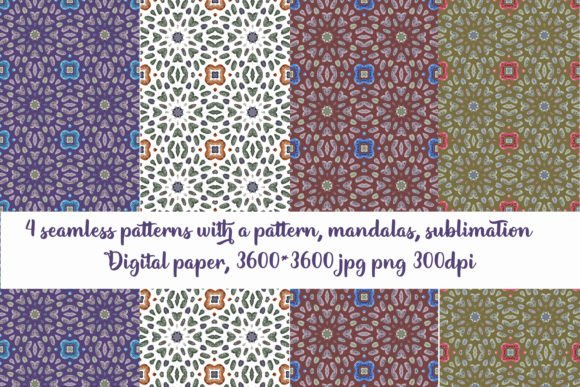
If you're designing for print-on-demand, crafting digital stationery, developing branded merchandise, or producing professional presentations, Seamless Patterns, Mandalas, Sublimation gives you a versatile, production-ready foundation — no design software expertise required. This digital download delivers four high-fidelity, tileable patterns built specifically for real-world use: clean geometry, balanced symmetry, and technical precision that holds up at any scale.
What Makes These Patterns Stand Out?
Each pattern is delivered as a 3600 × 3600 pixel file in both JPG and PNG formats, saved at true 300 DPI resolution. That means they’re optimized for sharp, artifact-free output — whether you’re printing fabric for sublimation mugs, laying down backgrounds for Canva social posts, or generating printable planner pages. The seamless tiling ensures zero visible seams when repeated, eliminating manual editing or patching in Photoshop.
The mandala-based designs go beyond decorative flair. They’re mathematically balanced — radial symmetry, consistent line weights, and intentional negative space — making them ideal for branding elements where harmony and intention matter. Unlike generic clipart or overused stock motifs, these are crafted with visual rhythm in mind: subtle variation within repetition, scalable detail, and color-ready transparency (in PNG) for layering over photos or gradients.
Where These Patterns Actually Get Used
Professionals across disciplines rely on reliable, licensable assets like these — not as “nice-to-have” extras, but as time-saving infrastructure. Here’s how they show up in practice:
- Sublimation Entrepreneurs: Apply the patterns directly to blank tumblers, phone cases, or ceramic tiles using heat transfer. Because the files are 300 DPI and seamless, your full-wrap designs stay crisp edge-to-edge — no blurry joins or stretched distortion.
- Educators & Trainers: Use mandala-patterned digital paper as printable worksheets, mindfulness journal pages, or presentation slide backgrounds. The symmetry supports focus and calm — especially helpful in SEL (social-emotional learning) materials or adult education handouts.
- Content Creators & Bloggers: Drop a pattern into a Canva template as a subtle background behind text blocks or quote graphics. The 3600px size scales cleanly down to Instagram story dimensions or up to A4 PDFs — one file, multiple outputs.
- Freelance Designers: Integrate them into client brand kits as secondary textures — think packaging liners, email newsletter dividers, or website section overlays. No need to build from scratch; just adjust hue or opacity to match brand guidelines.
No Layouts — Just Raw, Flexible Assets
This is a digital download only. You’ll receive the four pattern files — nothing more, nothing less. There are no pre-made layouts, mockups, or layered PSD files included. Why? Because flexibility matters. A designer who needs a repeating background for a Shopify product page doesn’t want locked layers. A teacher printing 50 copies of a guided meditation sheet doesn’t need an editable Illustrator file — just a clean, printable JPEG.
The sample layouts you may see online are strictly for demonstration. They exist to show how the patterns behave in context — how they tile across fabric, sit behind typography, or respond to color adjustments. But the value lies in what you *do* with them, not what someone else has already composed.
Realistic Considerations Before You Download
These patterns work best when matched to your workflow and goals. Ask yourself:
- Do you need transparency? Use the PNG version when layering over photos or colored backgrounds. JPG works perfectly for solid-color substrates (e.g., white sublimation blanks) or when file size is critical.
- Are you printing large-format? At 3600 × 3600 px, these scale cleanly up to ~12" × 12" at 300 DPI. For banners or wall graphics, you can repeat the tile programmatically in your design tool — no resampling needed.
- Is color accuracy essential? Files are provided in RGB (standard for digital use). If you’re preparing for CMYK offset printing, convert in your layout software — and soft-proof first. Sublimation printers handle RGB well, so no conversion is necessary there.
- What about licensing? These are for commercial use: you may apply them to physical products you sell, include them in digital templates you license, or use them in client work. You may not resell or redistribute the pattern files themselves as standalone assets.
Why Seamless Patterns, Mandalas, Sublimation Fits Real Workflows
Time is the most non-renewable resource for creators. Building a custom seamless pattern from scratch takes hours — researching tiling methods, testing repeats, adjusting spacing, exporting correctly. With Seamless Patterns, Mandalas, Sublimation, you skip straight to application. That hour saved becomes an extra client revision, a deeper content edit, or even 60 minutes reclaimed for strategy instead of setup.
It’s also about consistency. When your business uses the same underlying texture across your Etsy shop banner, product labels, and downloadable resources, customers subconsciously register cohesion — even if they never notice the pattern itself. That quiet reinforcement builds trust and recognition without shouting a logo.
And for educators or wellness professionals, mandalas aren’t just pretty shapes. Research shows structured radial imagery supports grounding and attention regulation. Using them intentionally — in printable breathwork guides, classroom calm corners, or workshop handouts — adds functional value beyond aesthetics.
A Note on Compatibility & Next Steps
These files open in virtually any design or office application: Adobe Photoshop, Illustrator, Affinity Suite, Canva, Microsoft PowerPoint, Google Slides, and even Apple Pages. No special plugins or fonts required. Just download, unzip, and drag into your project.
If you're evaluating similar assets elsewhere, check the tile boundaries — many “seamless” patterns fail at the edges when repeated. These have been manually verified across multiple tiling modes (offset, mirror, brick) to ensure integrity. And because they’re delivered at true 300 DPI — not upscaled — you avoid the softness or pixelation that plagues lower-res alternatives.
Questions about usage, licensing, or compatibility? Reach out directly. I’m here to clarify — not to upsell. This isn’t about pushing volume; it’s about delivering something genuinely useful, technically sound, and quietly powerful in daily creative work.