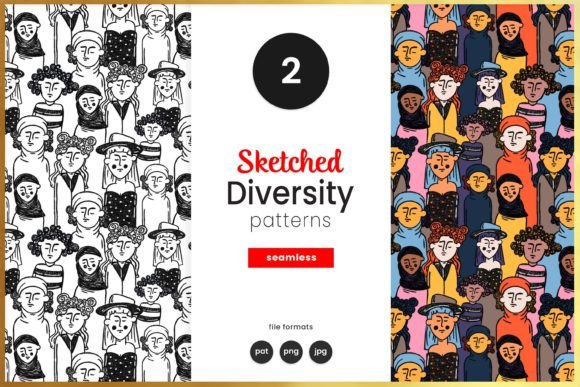
Multicultural and Diversity Patterns: Design That Celebrates Human Connection
Imagine a design resource that doesn’t just look good—but carries meaning. That invites inclusion, reflects shared humanity, and turns everyday products into quiet statements of respect and representation. That’s the heart of Multicultural and Diversity Patterns: not just visual assets, but thoughtful, scalable tools built to honor the richness of global identities.
What Exactly Are Multicultural and Diversity Patterns?
At their core, Multicultural and Diversity Patterns are seamless, repeatable design elements featuring illustrated figures—each intentionally varied in skin tone, hairstyle, attire, posture, and cultural cues—arranged harmoniously across a tileable surface. Unlike generic clipart or stylized silhouettes, these patterns prioritize authenticity and dignity: no stereotypes, no flattening of identity, just warm, confident, and diverse people coexisting in balanced, joyful composition.
These aren’t decorative afterthoughts. They’re foundational layers—designed from the ground up to scale across surfaces without visual breaks or repetition fatigue. Whether you're laying them out on fabric, packaging, or digital banners, they maintain rhythm, clarity, and emotional resonance.
Why Seamless Matters—And Why It’s Harder Than It Looks
“Seamless” isn’t just a buzzword—it’s a functional necessity for real-world use. A truly seamless pattern aligns perfectly at its edges so that when tiled, it creates an infinite, cohesive field. This is especially critical for print-on-demand (POD) workflows, where misaligned repeats cause visible seams on t-shirts, tote bags, or wallpaper—ruining both aesthetics and professionalism.
The Multicultural and Diversity Patterns collection includes two distinct seamless pattern files, each delivering this reliability in multiple formats: PAT (for direct Photoshop swatch integration), JPG (ideal for quick mockups and social media), and PNG (with transparent background for layered design). No manual tiling. No guesswork. Just plug-and-play versatility.
Who Benefits—and How
- Creative Entrepreneurs: Launch inclusive merchandise lines—think pride-themed apparel, classroom posters, or wellness journals—that resonate because they reflect real people, not abstractions.
- Educators & Nonprofits: Build welcoming learning environments with bulletin board backdrops, presentation slides, or handouts that affirm students’ identities from day one.
- Marketing Teams: Elevate brand storytelling with campaign visuals that avoid tokenism—using patterns as subtle, consistent backdrops that signal belonging without centering “diversity” as a trend.
- Independent Designers: Speed up client work with ready-to-adapt assets—swap colors, layer textures, or isolate individual figures (thanks to clean vector-informed illustration)—all while maintaining ethical representation.
Real-World Applications—Beyond the Obvious
Yes, these patterns shine on t-shirts and tote bags—but their strength lies in adaptability. Here’s how creators are using them in unexpected ways:
- Social Media Templates: A soft-repeat background behind quote graphics makes Instagram carousels feel grounded and human—not cold or corporate.
- Conference Branding: Used subtly in slide decks or virtual event backdrops, they reinforce values without distracting from content.
- Sticker Sheets & Planners: Individual figures can be extracted and repositioned as motivational icons—e.g., a person meditating, reading, gardening, or holding hands—supporting mental health or community themes.
- Children’s Book Mockups: Illustrators use the patterns as texture overlays for cover comps, testing how warmth and diversity read at thumbnail size.
What Sets These Patterns Apart—Ethically and Practically
Not all diversity-focused design is created equal. Many resources fall into common pitfalls: overly literal “checklist” imagery (e.g., one person per continent), inconsistent proportions, or low-resolution rendering that blurs nuance. The Multicultural and Diversity Patterns were developed with intentionality in mind:
- Thoughtful Stylistic Unity: Figures share a cohesive line weight, gentle shading, and expressive yet neutral facial language—ensuring harmony, not visual noise.
- Color-Inclusive Rendering: Skin tones span a broad, natural spectrum—not just light-to-dark gradients, but undertones that honor melanin variation.
- Cultural Nuance Without Appropriation: Hairstyles, headwear, and garments suggest heritage respectfully—no caricature, no costume, no single “representative” outfit per culture.
- Technical Precision: Each pattern was stress-tested across canvas sizes (from business card to billboard scale) to ensure crispness and edge alignment at every resolution.
Important Considerations—Transparency Over Hype
While powerful, Multicultural and Diversity Patterns aren’t magic wands—and that’s by design. A few practical notes:
- They’re illustrations—not photos. Display images shown in previews are for context only; actual product files contain only the seamless pattern assets. Photos, fonts, or mockup scenes are not included.
- Customization is encouraged—but requires basic design literacy. Changing colors or cropping works seamlessly in tools like Photoshop or Figma. However, editing individual figures demands familiarity with layers and selection tools.
- They support inclusion—they don’t replace it. Using these patterns thoughtfully means pairing them with authentic messaging, diverse hiring, and ongoing listening—not treating them as standalone “diversity solutions.”
Evaluating Fit: Is This Right for Your Project?
Ask yourself:
- Do you need a scalable, repeatable background—not a single focal image?
- Is your goal to signal inclusivity quietly and consistently, rather than make diversity the sole subject?
- Are you working within print-on-demand constraints (like limited color palettes or fabric bleed zones)?
- Do you value technical reliability over ultra-detailed realism? (These prioritize clarity and cohesion over photorealism.)
If most answers are “yes,” then Multicultural and Diversity Patterns likely align with your workflow—and your values.
A Final Thought: Design as Daily Practice
Great design doesn’t shout. It listens. It adapts. It makes space—not just visually, but emotionally and culturally. Tools like Multicultural and Diversity Patterns matter because they lower the barrier to doing that work well: no need to redraw from scratch, no risk of unintentional erasure, no compromise on quality.
They’re part of a larger shift—from seeing diversity as a “feature to add” to recognizing it as the default condition of human experience. And when that mindset lives inside your design files, it starts showing up everywhere else too.
So whether you’re launching your first Etsy shop or refreshing your company’s internal comms—choose patterns that don’t just fill space, but honor it.